

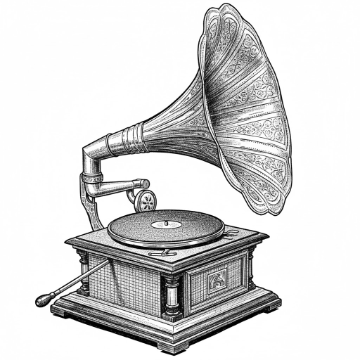
The Mechanics of Acoustical Recording
Before the advent of the vacuum tube and the microphone, the process of capturing sound was a purely physical, mechanical feat. This "Acoustic Era," which lasted from the commercial birth of the phonograph in the late 1880s until approximately 1925, relied entirely on the energy of the sound waves themselves to carve a groove into a spinning master disc. Without electronic amplification, performers were forced to adapt to a rigid, often uncomfortable studio environment where the laws of physics dictated every musical arrangement and vocal inflection.
The Recording Horn The centerpiece of the acoustic studio was the recording horn. These large, conical funnels were designed to gather sound waves and concentrate them at a single point. Made of brass, zinc, or even wood, the size and shape of the horn acted as a mechanical amplifier. Because the energy was limited, early recording artists had to thrust their heads directly into the mouth of the horn to ensure their voice carried enough force to vibrate the recording diaphragm. You can explore more about these early studio setups via the Discography of American Historical Recordings.
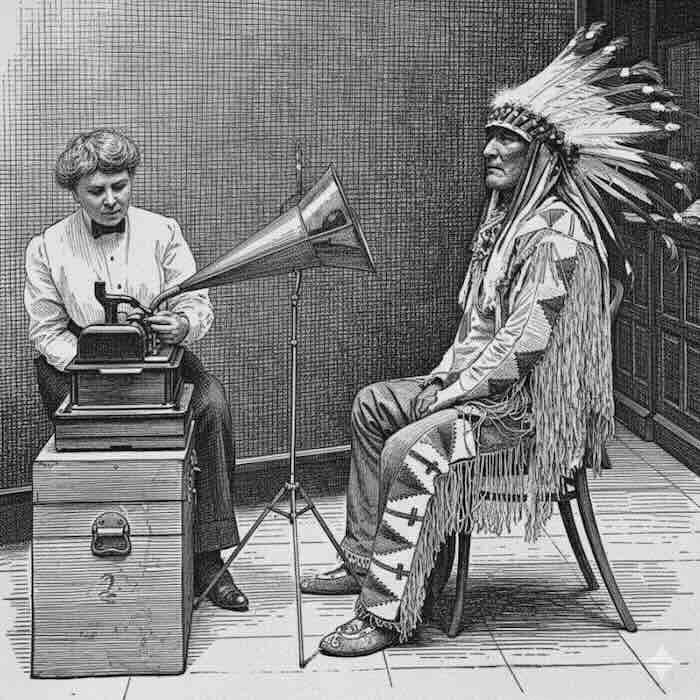 PLATE NO. I — ETHNOMUSICOLOGIST FRANCES DENSMORE AND MOUNTAIN CHIEF IN AN ACOUSTIC SESSION, CIRCA 1916.
The Cutting Head At the narrow end of the horn sat a thin, circular diaphragm made of glass, mica, or treated paper. Attached to this diaphragm was a sharp cutting stylus, usually made of sapphire or steel. As the sound waves struck the diaphragm, it vibrated, causing the stylus to move in sync with the audio. This stylus rested on a rotating "fat" master disc made of a soft, wax-like soap compound. The machine was driven by heavy weights or a powerful spring motor to ensure a constant speed, fluctuating at or about 78 revolutions per minute.
Physical Mixing Because there were no faders or volume knobs, "mixing" was done by moving the musicians. To balance an ensemble, the vocalist stood closest to the horn, while the brass instruments—which were naturally loud—were placed several feet back. Soft instruments like violins were often fitted with their own smaller horns (Stroh violins) to help project their sound toward the main receiver. If a singer hit a particularly powerful high note, they had to physically lean back to prevent the stylus from jumping out of the groove or "blasting" the wax. For a deeper look at specific session logs, the Library of Congress National Jukebox provides an excellent search engine for digitized acoustic-era tracks.
The Frequency Ceiling The acoustic method was notoriously poor at capturing extreme frequencies. Deep bass notes often lacked the energy to move the stylus, and high-frequency overtones were lost entirely. This resulted in the "canned" or "tinny" sound associated with early 78s. Despite these hurdles, the era produced legendary performances from the likes of Enrico Caruso and Bessie Smith, proving that the raw emotion of a performance could transcend the mechanical limitations of the sapphire needle.
The Electronic Revolution By 1925, Western Electric introduced the "Orthophonic" system, utilizing microphones and electromagnetic cutting heads. This rendered the giant recording horns obsolete overnight. However, the acoustic method remains a testament to human ingenuity—a time when sound was captured not as data or electrical pulses, but as a literal, physical impression of a moment in time, etched forever into a spinning plate of wax.